PixReenact: Pixel-Conditioned Causal Video Diffusion for Streaming Head-Avatar Reenactment

Gavriel Habib1, Dvir Samuel2, Or Shimshi1, Rami Ben-Ari1
1OriginAI, Israel   2NVIDIA

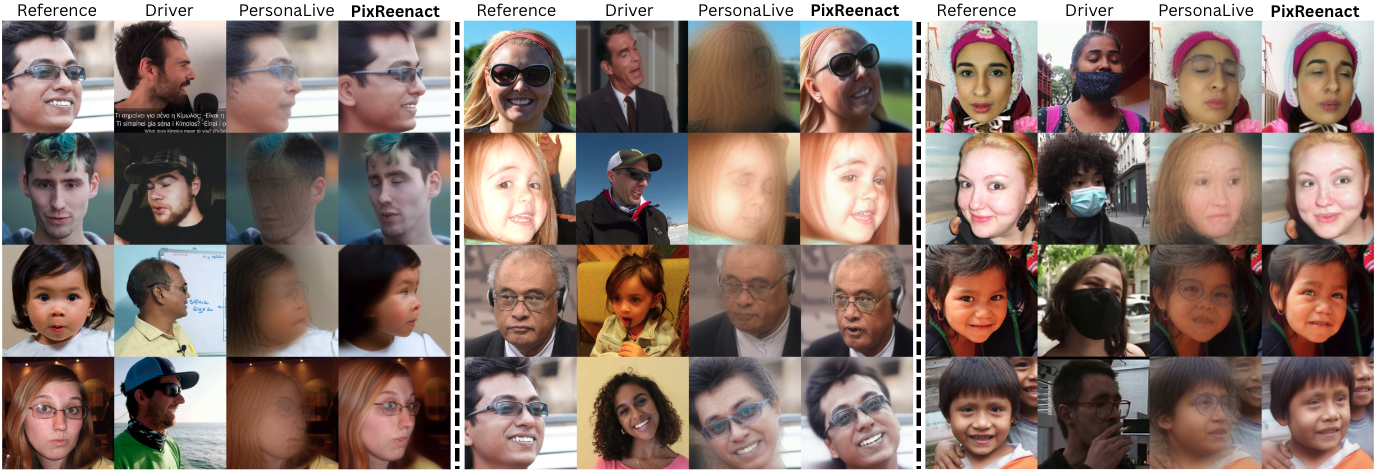
Extreme Viewpoints and Occlusions

Qualitative comparison under challenging viewpoints and occlusions

Qualitative comparison under challenging viewpoints and occlusions. Compared with PersonaLive, PixReenact better preserves the reference identity while following the driver's motion.

Long-Term Identity Stability

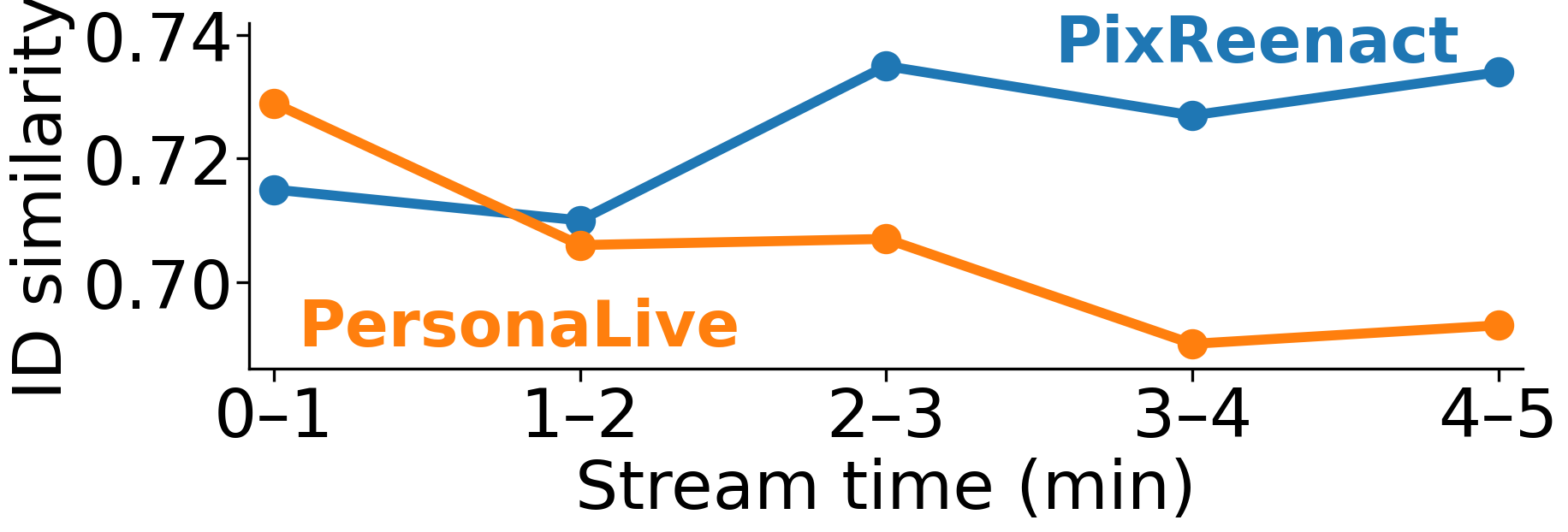
Autoregressive streaming models can slowly drift away from the reference identity as errors accumulate in the generated context. PixReenact is trained with long self-rollouts and remains stable far beyond its training horizon. The video below shows the first five minutes of a continuous PixReenact stream: the reference appearance stays intact while the avatar keeps following the driver.

Abstract

Streaming head-avatar reenactment aims to animate a reference image according to a live driving video, requiring robust motion transfer, long-term identity stability, and low latency. Existing methods often rely on specialized identity or motion representations, which can discard useful visual information and inherit failure modes from external extractors. In addition, many recent diffusion-based reenactment methods use offline, clip-based generation, jointly processing and denoising an entire video clip before producing its output, making continuous low-latency streaming difficult. We introduce PixReenact, a pixel-conditioned streaming reenactment framework built on causal video diffusion. PixReenact conditions directly on VAE-encoded reference and driving frames, without specialized identity or motion representations. To separate reference identity from driver motion, we train with cross-identity pseudo supervision together with corrective objectives anchored to the original reference and driving inputs. Long self-rollouts reduce autoregressive drift, while state-aware dual-teacher distillation separately addresses cold-start and steady-state generation. Across three cross-identity benchmarks and a long-horizon streaming benchmark, PixReenact demonstrates robust cross-identity reenactment, particularly under challenging conditions such as extreme viewpoints, occlusions, and pronounced facial expressions, while maintaining the reference identity over long streams. A 4-NFE rolling student continuously emits four frames per update with a mean emission latency of 239 ms.
Key Contributions

  • Pixel-driven streaming reenactment framework that conditions directly on VAE-encoded reference and driving frames, without specialized identity or motion representations for conditioning.
  • Training strategy for robust cross-identity streaming, combining cross-identity pseudo supervision, corrective objectives, and long self-rollouts to mitigate driver-appearance leakage and long-term autoregressive drift.
  • State-aware dual-teacher distillation, using separate cold-start and steady-state teachers to distill a 4-NFE causal student for low-latency continuous generation.

Method Overview

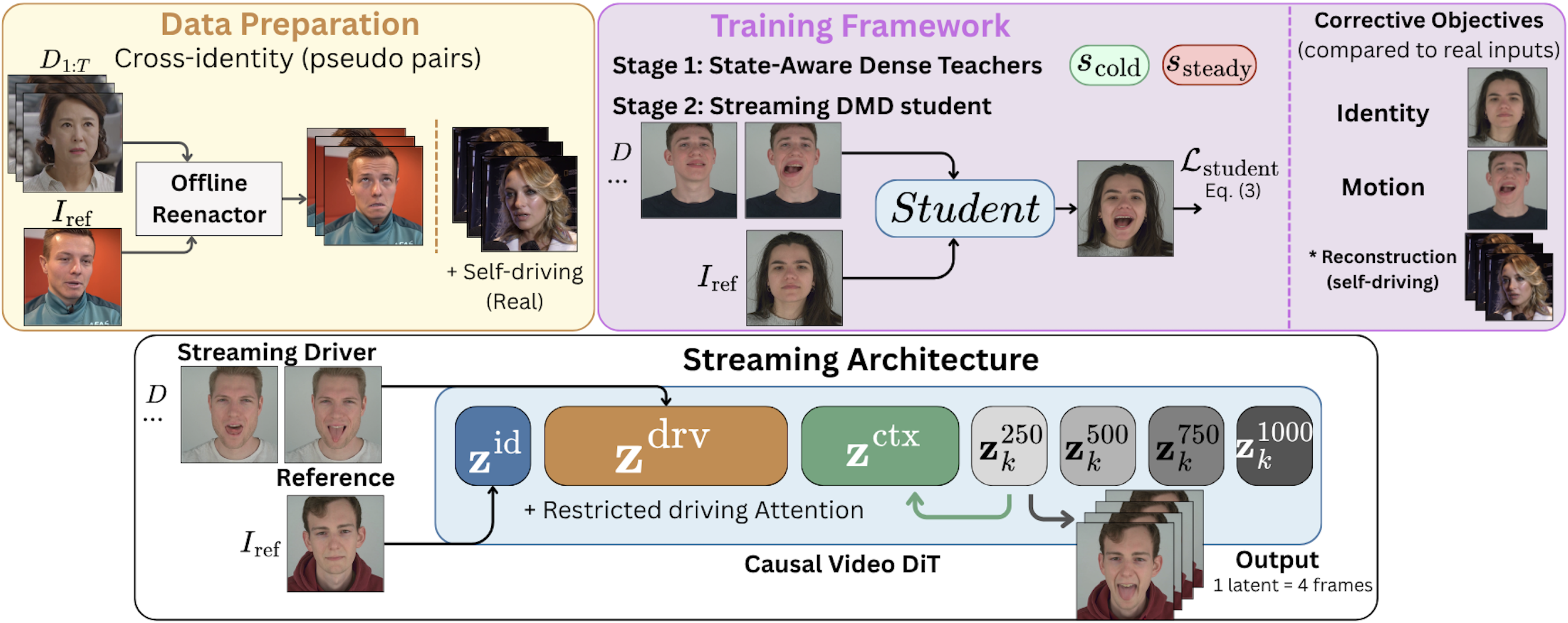
PixReenact method overview

PixReenact Overview. Top-left: offline cross-identity pseudo targets from real reference-driver pairs, plus real self-driving data. Top-right: cold-start and steady-state teachers are distilled into a 4-NFE student with DMD and corrective objectives. Bottom: reference, driving, and context latents condition a causal video DiT with restricted driving attention and rolling four-frame emission.

Results

We evaluate PixReenact on three cross-identity benchmarks — a 68-pair extreme-condition benchmark (FFHQ references driven by CelebV-HQ clips with large viewpoint changes and occlusions), a 75-pair public benchmark (TalkingHead-1KH and VFHQ drivers with FFHQ references), and a 70-pair NeRSemble benchmark — plus a long-horizon streaming benchmark of 28 five-minute videos. We measure identity preservation (ID, AdaFace cosine similarity to the reference), motion transfer (AED/APD, expression and pose distances to the driver), temporal consistency (tLP), video quality (FVD), and streaming runtime.

Extreme-condition benchmark (68 pairs)

MethodID ↑AED ↓APD ↓tLP ↓FVD ↓
PersonaLive 0.472 1.295 0.135 1.866 643.5
PixReenact 0.727 1.135 0.169 1.853 662.5

PixReenact's clearest advantage in this challenging setting is its substantially stronger reference-identity preservation. This highlights the importance of interpreting metrics jointly under extreme viewpoints and occlusions.

Standard cross-identity benchmarks

Method Public benchmark (75 pairs) NeRSemble (70 pairs) Runtime
ID ↑AED ↓APD ↓tLP ↓FVD ↓ ID ↑AED ↓APD ↓tLP ↓FVD ↓ Lat. (ms) ↓FPS ↑
Per-frame LivePortrait 0.8631.0710.2081.146579.0 0.8490.7870.08400.763302.4 –18.90
X-Portrait 0.7010.8870.0971.613595.2 0.7740.6940.04610.795281.2 –0.65
Offline MegActor-Σ 0.5540.8410.1061.910582.7 0.7290.8020.05660.976247.4 –0.49
Wan-Animate 0.5700.9660.0891.903579.2 0.6320.7890.03811.199201.3 –0.41
X-NeMo 0.6140.7750.0651.378449.1 0.7100.6390.02910.733276.5 –1.37
Wan-Animate-2 0.6030.8630.0854.500655.8 0.5830.7230.04511.831276.5 –0.29
FlashPortrait 0.7600.8640.1123.072633.7 0.8000.7580.05981.527303.2 –3.03
Streaming PersonaLive 0.6620.7880.0501.059407.1 0.7340.8240.03920.890310.0 211.118.95
PixReenact 0.7090.7900.0661.234377.1 0.7530.7140.04260.803264.8 238.916.74

Single-H200 runtime; latency is mean steady-state emission time per four-frame chunk. Better streaming results are shown in bold.

Long-horizon streaming

Long-term identity stability plot

Long-term identity stability. Mean AdaFace similarity per minute over 28 five-minute cross-identity videos. PersonaLive declines over time, while PixReenact remains stable.

Quality–Latency Trade-off

PixReenact uses a 4-NFE rolling denoising staircase, but the number of in-flight noise levels can be reduced at inference to trade quality for latency. With 3 NFEs, PixReenact matches PersonaLive's latency (211 ms) while still preserving identity far better on the extreme-condition benchmark; with 2 NFEs it becomes faster than PersonaLive (187 ms, 21.4 FPS). Fewer NFEs generally degrade motion fidelity and distribution quality (AED, APD, FVD), so the 4-NFE setting is our default. Quality metrics below are measured on the extreme-condition benchmark; best and second-best values are bold and underlined.

Method / NFEID ↑AED ↓APD ↓tLP ↓FVD ↓Lat. (ms) ↓FPS ↑
PersonaLive 0.4721.2950.1351.866643.5211.118.95
PixReenact, 4 NFE (1000, 750, 500, 250) 0.7271.1350.1691.853662.5238.916.74
PixReenact, 3 NFE (1000, 500, 250) 0.7311.1450.1742.008682.9211.418.92
PixReenact, 2 NFE (1000, 250) 0.7701.1910.1871.986753.6186.621.44

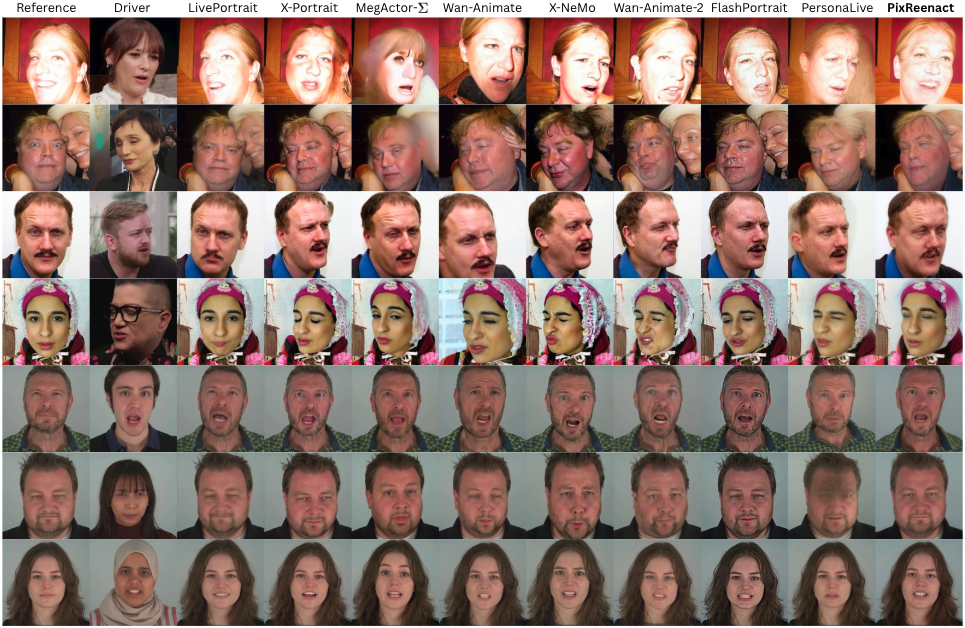
Qualitative Comparison with All Baselines

Qualitative comparison against all baselines

Cross-identity reenactment against all evaluated baselines. Qualitative comparisons on the public (rows 1–4) and NeRSemble (rows 5–7) benchmarks. PixReenact preserves the reference appearance while transferring the driver's facial motion.

Ethics & Responsible Use

Head-avatar reenactment can support beneficial applications such as telepresence and interactive digital agents, but it can also be misused to create deceptive or non-consensual representations of real people. PixReenact is a research system and is not designed to verify consent, authenticity, or ownership of its inputs. Deployment should therefore require appropriate consent and authorization for the identities being animated, and generated content should be clearly disclosed as synthetic when it could otherwise be mistaken for authentic footage. Our experiments use established research-oriented datasets and publicly available videos for research purposes only. We encourage future work on provenance, watermarking, and other safeguards for responsible deployment.

BibTeX

@article{habib2026pixreenact,
  author    = {Habib, Gavriel and Samuel, Dvir and Shimshi, Or and Ben-Ari, Rami},
  title     = {PixReenact: Pixel-Conditioned Causal Video Diffusion for Streaming Head-Avatar Reenactment},
  journal   = {arXiv preprint arXiv:2610.05233},
  year      = {2026},
}